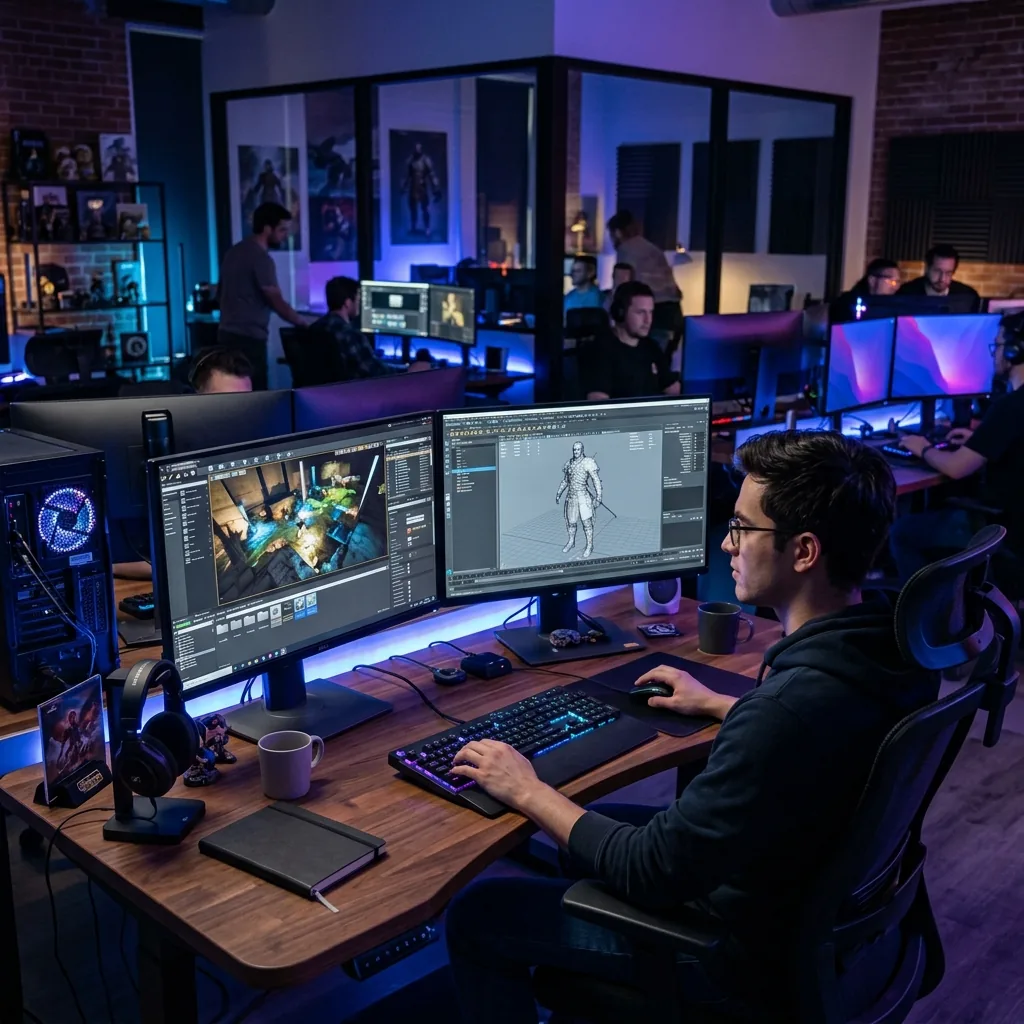
The year 2020 marked an unprecedented inflection point for the global video game industry. As social distancing and lockdowns forced billions of people indoors, gaming and streaming platforms experienced an explosion in engagement that forever altered the trajectory of interactive entertainment.
What began as a surge in playtime quickly evolved into a massive leap in underlying game engine technology. The tools and frameworks released during that pivotal year set the foundation for the hyper-realistic, cross-platform, AI-driven experiences we see today.
In this retrospective analysis, we explore the top 10 technological milestones of 2020 that fundamentally reshaped game development, lowering the barrier to entry for independent studios while pushing the boundaries of what AAA developers could achieve.
1. The Dawn of Unreal Engine 5
Perhaps the most seismic event in game development during 2020 was Epic Games’ announcement and tech demo of Unreal Engine 5. Released initially to developers to prepare for next-generation consoles (PlayStation 5 and Xbox Series X), UE5 focused on two revolutionary core technologies:
- Nanite (Virtualized Micropolygon Geometry): This allowed artists to import film-quality source art comprising hundreds of millions of polygons directly into the engine. Nanite streamed and scaled this geometry in real-time, effectively ending the era of “polygon budgets” and manually baking normal maps onto low-poly meshes.
- Lumen (Fully Dynamic Global Illumination): Lumen calculated lighting and shadows on the fly, reacting instantly to scene and light changes. Developers no longer needed to wait hours to “bake” lightmaps, saving thousands of hours in iteration time.
These features democratized photorealism, allowing smaller teams to achieve visuals previously restricted to massive AAA studios.
2. Unity’s Push Toward Data-Oriented Design (DOTS)
While Epic pushed photorealism, Unity aggressively pursued raw, scalable performance. Throughout 2020, Unity expanded its Data-Oriented Technology Stack (DOTS), a radical shift from traditional object-oriented programming.
By utilizing the Entity Component System (ECS), the C# Job System, and the Burst Compiler, DOTS allowed Unity3D development teams to process massive amounts of data across multiple CPU cores simultaneously. This meant games could render tens of thousands of complex units on screen at once—enabling massive city simulators and grand strategy games to run smoothly on mid-range hardware and even mobile devices.
3. AI Voice Cloning: Respeecher and Resemble AI
Before 2020, voicing an expansive RPG meant hiring hundreds of actors and recording thousands of hours of dialogue—a massive bottleneck for indie developers.
In 2020, AI companies like Resemble AI and Respeecher began releasing dedicated Unity and Unreal plugins for synthetic voice generation. Developers could now generate localized dialogue, create varied NPC barks, and style speech based on emotion directly within the engine. This technology laid the groundwork for the fully dynamic, LLM-driven NPCs we see in modern game development.
4. Open-Source Surges: Godot and ezEngine
While Unity and Unreal dominated the proprietary market, 2020 was a breakout year for open-source alternatives.
- Godot Engine: Saw massive adoption due to its lightweight nature, intuitive node-based architecture, and highly permissive MIT license. It became the darling of 2D developers and game jam participants.
- ezEngine: An open-source C++ 3D game engine that provided a built-in editor allowing creators to manipulate scenes and assets without the overhead of massive corporate engines. Its availability on GitHub empowered developers who wanted absolute control over their engine source code.
5. Microsoft DirectX 12 Ultimate and Linux Support
Microsoft’s DirectX team made huge waves by announcing DirectX 12 Ultimate, standardizing the feature set across Windows PCs and the upcoming Xbox consoles. Features like DirectX Raytracing (DXR), Variable Rate Shading (VRS), and Mesh Shaders became the new baseline for high-end rendering.
Unexpectedly, Microsoft also announced GPU hardware acceleration support for Linux subsystems, allowing Linux Kernel Mode Drivers (KMD) to communicate with Windows GPU hardware. This was a massive boon for developers building cross-platform server architectures for multiplayer games.
6. NoesisGUI and the UI Evolution
User Interfaces in games have historically been incredibly difficult to optimize, often consuming a disproportionate amount of memory and rendering time.
In 2020, Noesis Technologies released major updates to NoesisGUI, bringing vector-based, XAML-driven UI design (similar to WPF) to game engines. By drastically reducing memory usage and running on the GPU, developers were able to create fluid, animated, 4K-ready user interfaces that didn’t drag down the game’s framerate.
7. Blender’s Dominance in 3D Modeling
Blender, the free and open-source 3D creation suite, hit a massive stride in 2020. Thanks to its revolutionary “Eevee” real-time rendering engine introduced in version 2.8, the software saw massive financial backing from industry titans like Epic Games, Ubisoft, and NVIDIA.
Furthermore, the community released thousands of powerful add-ons (like procedural house builders and environment generators), making Blender the default tool for indie game artists and a serious competitor to expensive software like Maya and 3ds Max.
8. The Massive Expansion of the Mobile Market
The COVID-19 lockdowns proved the absolute dominance of mobile gaming. In 2020 alone, mobile game playtime increased by 62%, and in-app purchases surged by 46%.
This forced traditional PC/Console developers to rethink their strategies, leading to a massive increase in cross-platform development. Mobile application development techniques merged with game design, resulting in highly optimized “lite” versions of massive games (e.g., PUBG Mobile, Call of Duty Mobile) that generated billions in revenue.
9. High-Fidelity Audio Libraries Become Accessible
Immersive audio is half the player experience. Historically, capturing high-quality Foley (sound effects like explosions, footsteps, and gunshots) required expensive field recording equipment.
In 2020, companies like Bluezone released extensive, royalty-free sound libraries—such as highly detailed tank explosion and weapon sound effects—specifically tailored for game developers. These accessible libraries allowed small, low-budget teams to create auditory experiences that rivaled AAA military shooters.
10. The Rise (and Struggle) of Cloud Gaming and Live-Service
2020 was the year tech giants heavily invested in cloud gaming and live-service models. Amazon Game Studios launched Crucible, a team-based shooter. While Crucible ultimately failed and was shut down shortly after launch, it highlighted the intense difficulty of the “Games as a Service” (GaaS) model.
It taught the industry a valuable lesson: relying solely on cloud infrastructure (like AWS) and multiplayer trends is not enough to sustain a game; core gameplay loops and community building are paramount. This led to a massive pivot in how studios approached post-launch live operations over the following years.
Frequently Asked Questions
Why was 2020 such an important year for game engines? The announcement of Unreal Engine 5 (with Nanite and Lumen) and the expansion of Unity’s DOTS architecture fundamentally changed how developers handled lighting, physics, and rendering. It shifted the industry away from manual optimization (like baking lights and creating LODs) toward dynamic, real-time calculation.
Is Unity or Unreal better for a beginner today? It depends on the project. Unity remains the king of mobile, 2D, and AR/VR development due to its vast asset store and C# scripting. Unreal Engine is generally preferred for high-end, 3D photorealistic games on PC and console, largely due to its Blueprints visual scripting system and out-of-the-box graphical fidelity.
Did mobile gaming stay popular after the 2020 lockdowns? Yes. The 2020 surge permanently expanded the gaming demographic. Mobile gaming currently generates more revenue than the PC and console markets combined, driven largely by microtransactions, gacha mechanics, and ad-supported hyper-casual games.
What is the role of AI in modern game development? While 2020 saw the rise of AI voice cloning, today AI is used across the entire development pipeline. This includes procedural generation of environments, LLMs powering dynamic NPC dialogue, and AI-driven quality assurance testing.
Can I build a successful game using open-source tools? Absolutely. You can build a complete, commercial game using entirely free and open-source software like the Godot Engine for programming, Blender for 3D modeling, Krita for 2D art, and Audacity for sound mixing.
Build the Future of Gaming with NSDBytes
The tools available to game developers today are more powerful—and more complex—than ever before. Navigating this landscape requires deep technical expertise in modern engine architecture, cross-platform deployment, and scalable backend infrastructure.
At NSDBytes, our specialized game development teams leverage the latest advancements in Unity, Unreal, and cloud architecture to build immersive, high-performance interactive experiences. Whether you are building a casual mobile hit or a complex multiplayer ecosystem, we have the talent to bring your vision to life.
Start your game development journey with NSDBytes →
Related Articles
Frequently Asked Questions

Written by the NSDBytes Team
We are passionate about software development, AI integration, and helping businesses achieve operational excellence through modern technology.
Need something like this built?
We’ve helped 200+ companies build and scale production-grade software.