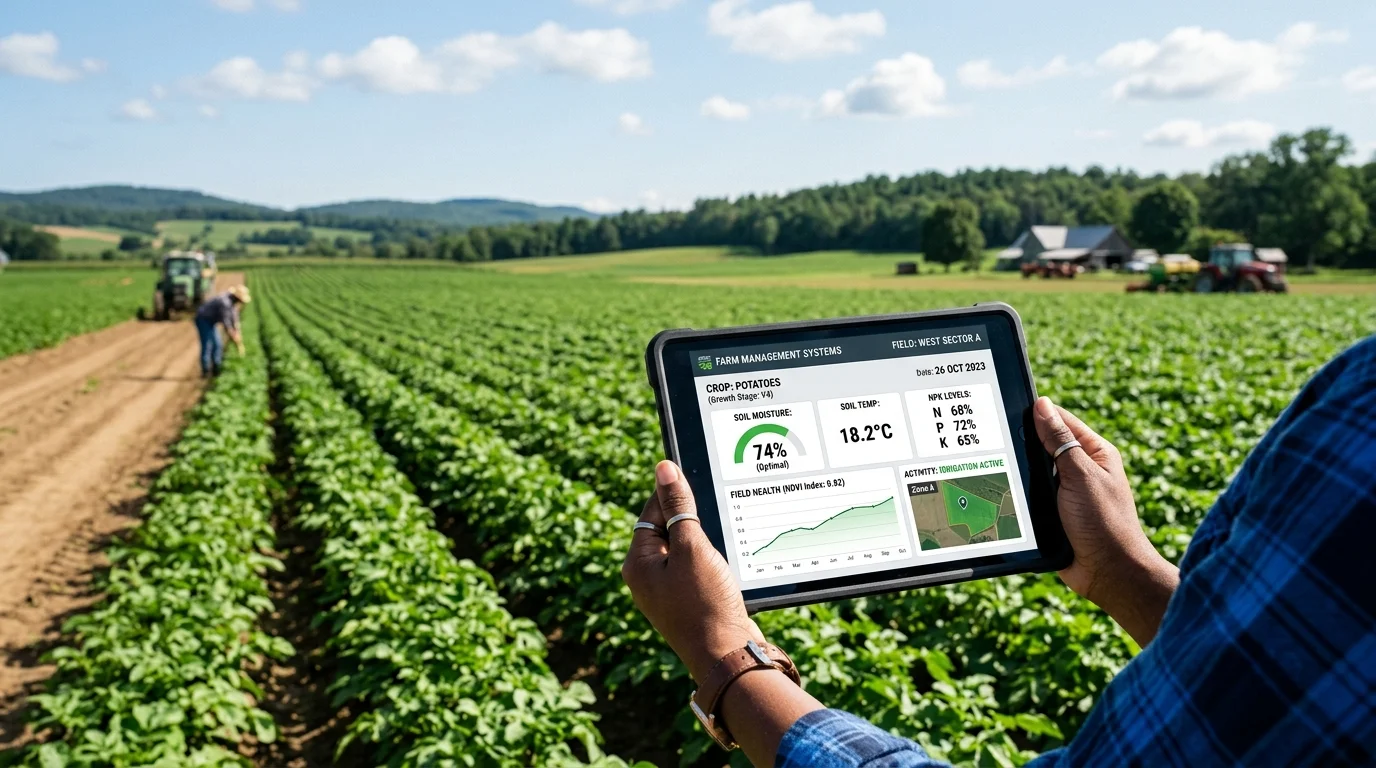
 Agriculture is a $4 trillion global industry that feeds 8 billion people. It’s also one of the least digitized sectors in the world. While financial services, healthcare, and retail have undergone waves of digital transformation, most farming operations still rely on generational knowledge, weather intuition, and paper-based record keeping.
This gap is an enormous opportunity. The agritech market is projected to reach $43 billion by 2030, driven by labor shortages, climate unpredictability, population growth, and the simple economic reality that data-driven farming produces more food with fewer resources.
At NSDBytes, we build agritech software that connects the physical world of farming with the digital tools needed to optimize it. This guide explores where technology delivers the highest impact in modern agriculture.
Why Agriculture Needs Software Now
Three converging forces make agricultural digitization urgent rather than optional:
1. The labor crisis. The average age of a farmer in the United States is 58. Globally, rural populations are declining as younger generations move to cities. Farming operations must produce more with fewer hands — and technology is the only path to achieving that.
2. Climate unpredictability. Traditional farming relied on predictable weather patterns built over generations. Climate change has disrupted these patterns. Droughts, floods, unseasonal temperatures, and pest migrations are increasing in frequency and severity. Data-driven decision-making helps farmers adapt to conditions that historical knowledge can’t predict.
3. Margin pressure. Input costs (seeds, fertilizer, fuel, labor) are rising. Commodity prices fluctuate unpredictably. Farmers need to optimize every acre’s productivity while reducing waste. Precision agriculture — applying the right inputs, at the right time, in the right place — is the answer.
Core Applications of Agritech Software
1. Farm Management Platforms
A farm management platform is the operating system for modern agriculture. It centralizes the data and decisions that drive farm operations.
Essential features:
- Field mapping: GPS-based field boundaries, soil zones, and topographic data visualized on interactive maps
- Crop planning: Season-by-season planning with crop rotation schedules, planting dates, and expected yields
- Input management: Track seed varieties, fertilizer applications, pesticide usage, and irrigation schedules at the field level
- Labor management: Task assignment, time tracking, and crew scheduling
- Financial tracking: Input costs, yield revenue, profit per field/crop, and season-over-season comparisons
- Compliance documentation: Automatic record generation for organic certification, food safety audits, and regulatory reporting
The platform advantage: Instead of managing these functions in separate spreadsheets, notebooks, and apps, a unified platform creates a single source of truth that’s accessible from a phone in the field or a computer in the office.
2. Precision Agriculture and IoT
Precision agriculture is the practice of using data to make field-level (or even plant-level) management decisions instead of treating entire farms uniformly.
Sensor infrastructure:
- Soil sensors: Measure moisture, temperature, pH, nitrogen, phosphorus, and potassium levels at multiple depths. Data transmitted wirelessly to the cloud.
- Weather stations: On-farm microclimate data (temperature, humidity, wind, rainfall, solar radiation) that’s far more accurate than regional weather forecasts
- Drone imagery: Multispectral cameras capture crop health data across entire fields in minutes. NDVI (Normalized Difference Vegetation Index) maps highlight stress zones invisible to the naked eye.
- Satellite imagery: Lower resolution than drones but covers large acreage at low cost. Sentinel-2 satellite data is freely available and sufficient for many monitoring applications.
Data-driven decisions:
- Variable rate application: Instead of applying 200 lbs/acre of fertilizer uniformly, precision maps identify zones that need 150, 200, or 250 lbs — reducing waste by 15–20% while improving yields
- Irrigation optimization: Soil moisture sensors trigger irrigation only when and where needed, reducing water usage by 20–30%
- Pest and disease early warning: Combination of weather data, crop imagery, and predictive models identifies disease-favorable conditions before symptoms appear
3. Crop Monitoring and AI-Powered Diagnostics
Computer vision for crop health:
AI models trained on millions of crop images can identify diseases, nutrient deficiencies, and pest damage from smartphone photos or drone imagery.
- Disease identification: Point a phone at a leaf and get instant identification of the disease plus treatment recommendations
- Weed detection: Differentiate crop from weed at the plant level, enabling targeted herbicide application (spot spraying) instead of blanket application
- Yield estimation: Analyze drone or satellite imagery to predict yields weeks before harvest, helping with marketing and logistics planning
- Growth stage tracking: Automated monitoring of crop development against expected benchmarks
The data pipeline:
- Images captured via drone, satellite, or smartphone
- Preprocessing (georeferencing, stitching, radiometric correction)
- AI model inference (disease detection, vegetation analysis, counting)
- Results mapped back to field coordinates
- Recommendations generated and pushed to the farm management platform
4. Supply Chain Traceability
Consumers, retailers, and regulators increasingly demand transparency about where food comes from and how it was produced.
Traceability system components:
- Farm-level recording: What was planted, what inputs were applied, when it was harvested, and by whom
- Processing documentation: Receiving records, batch processing data, quality test results
- Distribution tracking: Cold chain monitoring, transportation conditions, chain of custody
- Consumer-facing transparency: QR codes on packaging that link to the product’s complete journey from farm to shelf
Business benefits:
- Premium pricing: Traceable, sustainably produced food commands 10–30% price premiums
- Recall efficiency: When a food safety issue arises, traceability narrows the recall scope from “all lettuce from Region X” to “lettuce from Field 7, harvested on Date Y”
- Regulatory compliance: Food Safety Modernization Act (FSMA) and similar regulations worldwide mandate traceability. Digital systems make compliance automatic rather than burdensome.
- Market access: Many retailers (Walmart, Costco, Whole Foods) require digital traceability as a condition of doing business
5. Agricultural Marketplace Platforms
Connecting farmers directly with buyers — processors, retailers, restaurants, or consumers — through digital marketplaces.
Platform features:
- Product listings with quality grades, certifications, availability dates, and pricing
- Order management with delivery coordination and payment processing
- Price discovery based on real-time market data and commodity indices
- Contract farming tools for pre-season agreements with guaranteed volumes and prices
- Quality verification through photo documentation and third-party inspection integration
Technology Stack for Agritech
Building agritech software requires a specialized technology approach:
Mobile-first design: Farmers work in fields, not offices. Every feature must be usable on a phone with one hand, often in direct sunlight. Offline capability is essential — cellular coverage is unreliable in rural areas.
IoT data infrastructure:
- MQTT protocol for lightweight sensor communication
- LoRaWAN for long-range, low-power sensor networks covering large farm areas
- Time-series databases (InfluxDB, TimescaleDB) for efficient sensor data storage
- Edge processing for real-time alerts without cloud latency
Geospatial capabilities:
- PostGIS for spatial database queries
- MapBox or Leaflet for interactive mapping
- GDAL for raster data processing (satellite and drone imagery)
- GeoServer for serving map tiles
AI/ML pipeline:
- PyTorch or TensorFlow for computer vision models
- scikit-learn for tabular prediction models (yield forecasting, disease risk)
- MLflow for model versioning and deployment
- Label Studio for training data annotation
Implementation Roadmap for Agritech Projects
Phase 1: Foundation (8–12 weeks)
- Core farm management platform (field mapping, crop planning, basic record keeping)
- Mobile app with offline capability
- User training and onboarding
Phase 2: Intelligence (12–16 weeks)
- IoT sensor integration (soil, weather)
- Satellite/drone imagery analysis
- Basic analytics dashboard
Phase 3: Optimization (Ongoing)
- AI-powered recommendations (variable rate prescriptions, disease alerts)
- Supply chain traceability
- Marketplace integration
- Predictive analytics
Frequently Asked Questions
Do farmers actually use software? Adoption rates are accelerating rapidly. Younger farmers and large operations lead adoption, but even traditional farmers are embracing mobile apps for weather, market prices, and basic record keeping. The key is building software that’s genuinely useful and simple enough to use while standing in a field.
What’s the ROI of precision agriculture? Precision application reduces input costs and lifts yield, and the effect compounds across a large acreage. How much depends on field variability: uniform, already well-managed fields see modest gains, while fields with strong zone-to-zone variation see the most. Model it against your own soil sampling rather than a headline percentage.
How do you handle connectivity in rural areas? Offline-first design is essential. Our agritech applications cache data locally, sync when connectivity is available, and function fully without internet access. For IoT sensors, LoRaWAN networks provide 10+ km range with minimal infrastructure, and satellite connectivity (Starlink, cellular IoT) is increasingly available.
Can agritech software integrate with existing farm equipment? Yes, through the ISOBUS/ISO 11783 standard used by major equipment manufacturers (John Deere, Case IH, AGCO). This standard enables data exchange between farm software and tractors, sprayers, combines, and planters for automated variable rate application.
Is agritech only for large-scale operations? No. While large operations benefit most from IoT sensors and variable rate technology, smallholder farmers benefit enormously from mobile-based farm management, weather alerts, market price information, and disease identification tools. Many successful agritech companies serve smallholder farmers in developing markets.
Build Your Agritech Solution with NSDBytes
At NSDBytes, we build agricultural technology solutions that are practical, scalable, and designed for the realities of farming — not the idealized version.
From IoT-powered precision farming platforms to mobile farm management apps to supply chain traceability systems, we help agribusinesses and agritech startups turn agricultural data into operational advantage.
Discuss your agritech project →
Related Articles
Frequently Asked Questions

Written by the NSDBytes Team
We are passionate about software development, AI integration, and helping businesses achieve operational excellence through modern technology.
Need something like this built?
We’ve helped 200+ companies build and scale production-grade software.