REST and GraphQL APIs
Back ends for web and mobile apps, written in TypeScript with tests and API documentation.

Node.js development
Node.js runs JavaScript on the server. It is strong at APIs and real-time features, and it is the back end of GMS, our own hotel product.
01 / What we build
Back ends for web and mobile apps, written in TypeScript with tests and API documentation.
Chat, live dashboards and notifications over WebSockets.
Services that sit between your product and third-party systems, with retries and logging.
Queues and scheduled work for email, imports, reports and webhooks.
02 / How it connects
A single slow calculation blocks every request. Heavy work has to move to a worker or a queue.
Node imposes little. We set conventions, TypeScript and linting at the start so the code stays readable.
npm projects pull in many packages. Auditing and updating them is ongoing work, not a one-off.
03 / Proof
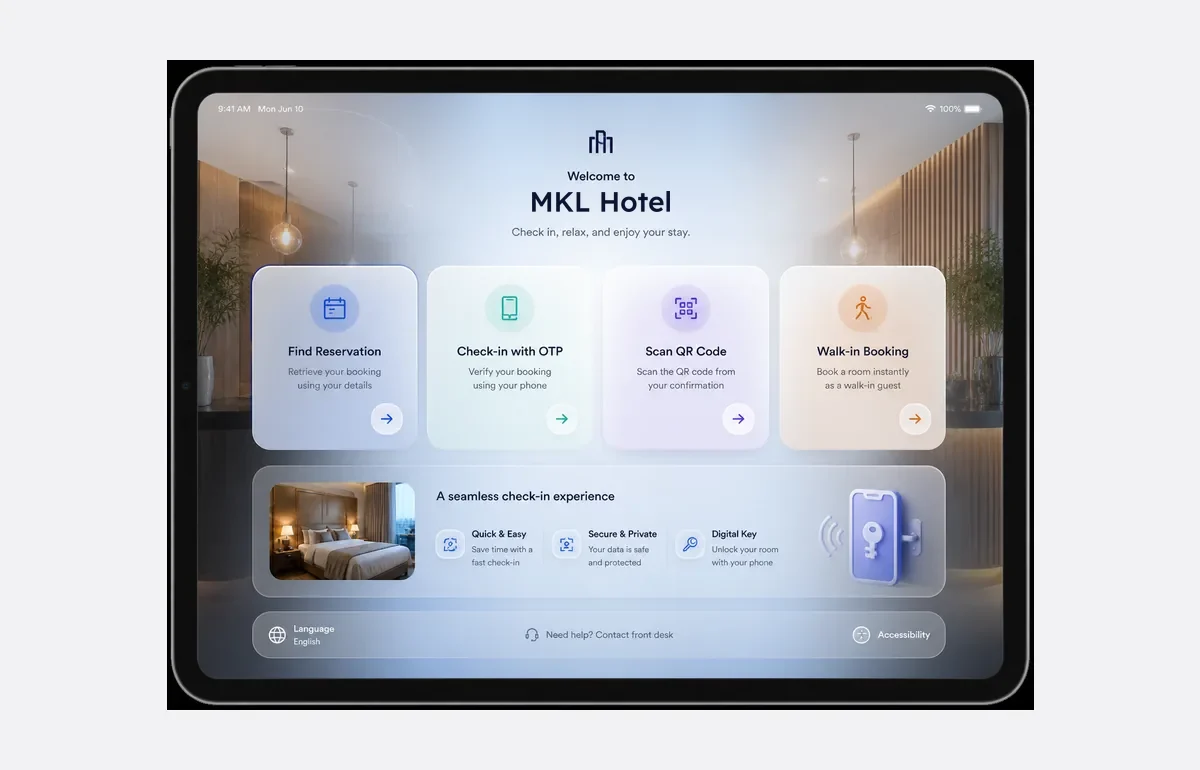
Our own product / Hospitality
The GMS guest platform runs on Node.js, Express and MongoDB behind a Flutter app. It is live at 9 of MKL Hospitality Group’s 10 properties.
Read the GMS case studyAlso in Node.js: The MKL Hospitality rollout
Further reading

Real-time Node.js past the tutorial stage: connection state, backpressure, horizontal scaling, and what breaks first when concurrency climbs.
Read insightA little clarity
We agree what the first release must do and write the API contract before the code, so front-end and mobile work can proceed in parallel. The service is built in TypeScript with automated tests, reviewed on a staging environment, then released with logging and monitoring. Bugs are fixed free for 30 days.
Node.js is our choice for APIs and real-time features, and it runs the back end of GMS. For a conventional business application with many forms and reports, Laravel or .NET gives more structure out of the box, and we recommend those where they fit.
You own the code, designs and documentation made for you once the final invoice is paid. Servers, databases and third-party accounts are created in your name, so nothing runs on infrastructure only we can reach. Node.js itself is open source.
Define the first few endpoints and the data behind them, and build that as a fixed first release, from $5,000. Back ends tend to grow with the product, so a dedicated developer from $4,000 a month is the usual model once the direction is proven.
Services are stateless, so more copies can run behind a load balancer. Slow work goes to queues, frequent reads go to a cache, and the database is indexed for the queries the product really makes. No architecture guarantees scale, so we load test where the expected traffic justifies it, then monitor and adjust.
Start wherever you are
Tell us what it has to handle and what it connects to. We will say whether Node.js is the right runtime before we quote.