The way businesses interact with AI is undergoing a fundamental shift. For years, integrating AI into your existing tech stack meant expensive custom development, brittle API workarounds, and a constant cycle of maintenance headaches. In 2025, a new standard is changing that — and if you’re a business leader or technical decision-maker, it’s one you need to understand.
That standard is Model Context Protocol (MCP).
At NSDBytes, we’ve been helping businesses leverage cutting-edge AI infrastructure since the early days of enterprise AI adoption. MCP represents one of the most significant architectural leaps we’ve seen — and understanding it could be the difference between an AI strategy that scales and one that stalls.
What Is MCP, and Why Does It Matter?
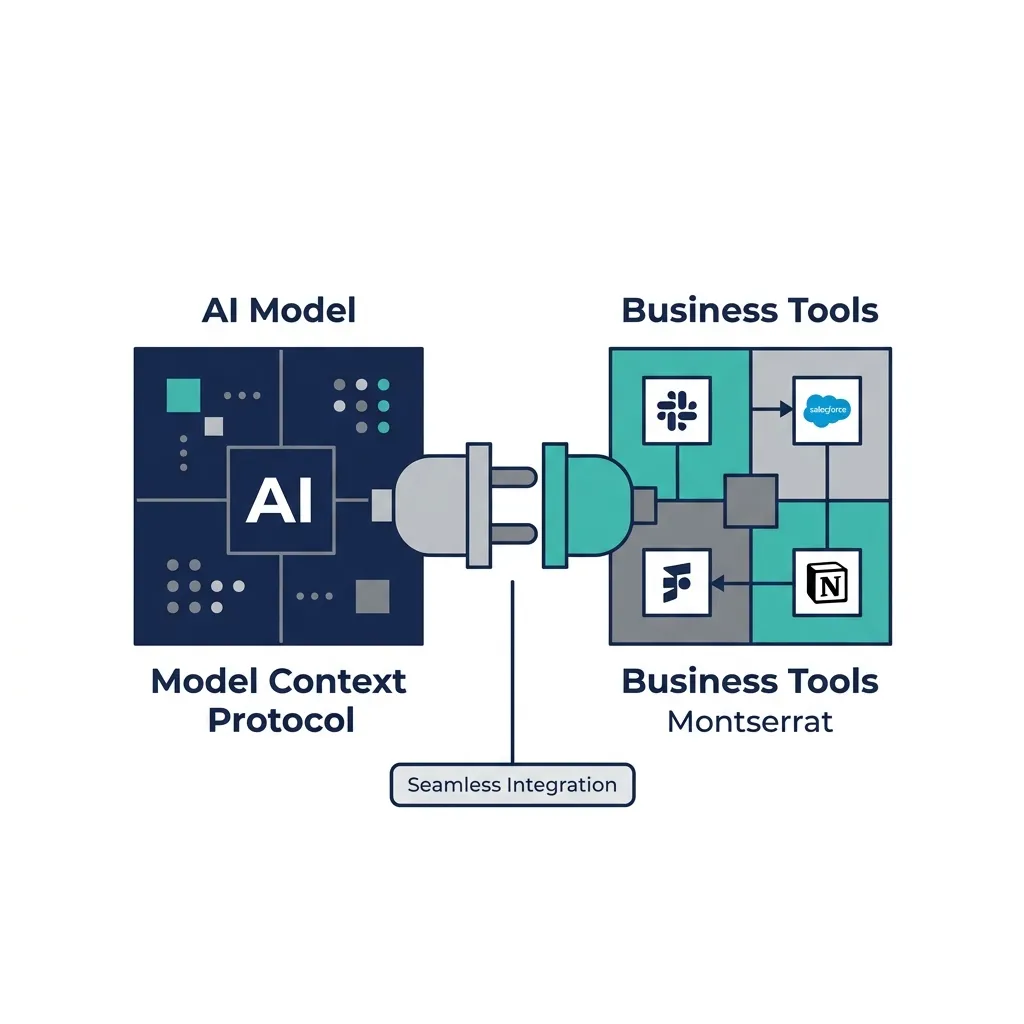
Model Context Protocol is an open standard, originally introduced by Anthropic, that defines a universal way for AI models to connect with external tools, data sources, and business systems. Think of it as the USB-C of AI integration — a single, standardized connector that works across different tools, platforms, and models.
Before MCP, connecting an AI assistant to your CRM, your project management software, your internal database, or your customer support platform required building a unique integration for each one. Every tool spoke a different language, and every connection had to be custom-engineered from scratch.
MCP eliminates that friction by establishing a common protocol. Once a tool exposes an MCP server, any compatible AI model — whether that’s Claude, GPT-4, or an open-source alternative — can connect to it, read data from it, and take actions within it, all through a standardized interface.
How MCP Actually Works
Understanding MCP at a technical level doesn’t require a computer science degree. Here’s a practical breakdown:
The Client-Server Model
MCP operates on a simple client-server architecture:
- The MCP Host is the AI application — the large language model or AI assistant your team is using.
- The MCP Client is the component within that AI application that manages the connection.
- The MCP Server is the lightweight adapter that sits in front of your business tool (your CRM, your database, your file system, your APIs) and exposes its capabilities in a language the AI understands.
When your AI needs to pull a customer record, check inventory, or create a support ticket, it communicates through this protocol — cleanly, securely, and consistently.
What MCP Servers Can Expose
An MCP server can expose three types of capabilities to an AI model:
- Resources — Read-only data like documents, database records, or file contents
- Tools — Actions the AI can take, such as sending an email, updating a record, or triggering a workflow
- Prompts — Pre-defined templates that guide the AI on how to interact with the tool effectively
This layered structure gives businesses granular control over what the AI can see and do — a critical requirement for enterprise adoption.
Why This Is a Game-Changer for Business Leaders
The implications of MCP go well beyond developer convenience. At NSDBytes, we work directly with CTOs and founders navigating AI adoption, and MCP addresses several pain points we hear consistently.
Dramatically Reduced Integration Costs
Traditional AI integrations are expensive to build and even more expensive to maintain. Every time a SaaS vendor updates their API, your custom integration breaks. With MCP, the responsibility shifts. Tool vendors build and maintain their own MCP servers. Your AI application simply connects to them. The integration work drops by a significant margin, freeing your engineering team to focus on higher-value problems.
A Future-Proof Architecture
The AI landscape is evolving rapidly. The model you deploy today may not be the best option in 18 months. With a non-standardized integration approach, switching models means rebuilding your entire integration layer. With MCP, your integrations are model-agnostic. You can swap out the underlying AI without touching your business tool connections. That kind of flexibility is essential for businesses that want to stay competitive as AI capabilities advance.
Giving AI Real Business Context
One of the most persistent limitations of AI in enterprise settings has been the lack of context. A generic AI model doesn’t know your specific customer history, your internal knowledge base, or the current state of your projects. MCP solves this at the architectural level. By connecting your AI to the systems where your business data actually lives, you’re not just asking the AI to be smarter — you’re giving it the information it needs to be genuinely useful.
Enterprise-Grade Security and Control
Business leaders rightly worry about what AI can access and do. MCP’s architecture supports fine-grained permission controls. You decide which resources and tools are exposed to the AI, and your MCP servers act as a controlled gateway — not an open door. Our team at NSDBytes always emphasizes building with security-first principles, and MCP’s design aligns directly with that philosophy.
Real-World Use Cases in 2025
The practical applications of MCP are already being deployed across industries. Here are a few scenarios that illustrate its power:
-
Sales and CRM Intelligence — An AI assistant connected via MCP to Salesforce can pull real-time deal data, summarize account histories, draft follow-up emails, and log call notes — all within a single conversation, without manual switching between tools.
-
Internal Knowledge Management — Connect your AI to Notion, Confluence, or SharePoint through MCP servers, and your team gets an intelligent assistant that actually knows your company’s processes, documentation, and institutional knowledge.
-
Automated Development Workflows — Engineering teams can connect AI coding assistants to GitHub, Jira, and CI/CD pipelines. The AI can read ticket requirements, check the current codebase, propose changes, and even open pull requests — all through standardized MCP connections.
-
Customer Support Automation — AI agents connected to your support ticketing system, your product database, and your customer records can resolve inquiries with full context — not just scripted responses, but genuinely informed answers.
What You Should Be Doing Right Now
If you’re a business leader evaluating AI strategy in 2025, here’s what our team recommends:
-
Audit your current integration approach. If you have custom AI integrations that break frequently or require significant maintenance, MCP offers a clear path to a more sustainable architecture.
-
Look for MCP-compatible tooling. Major platforms including Slack, GitHub, Google Drive, and dozens of others have already published MCP servers. Check whether the tools your business relies on have MCP support.
-
Start with one high-value use case. Rather than attempting a full-scale AI integration overhaul, identify a single workflow where connecting AI to your business data would create immediate, measurable value. Build that first.
-
Partner with a team that understands the full stack. MCP is powerful, but deploying it effectively requires understanding both the AI layer and the business systems layer. That’s precisely where NSDBytes adds value — bridging the gap between emerging AI standards and real-world enterprise systems.
The Bottom Line
MCP is not a buzzword or a fleeting trend. It’s an infrastructure shift — one that makes AI genuinely operable within the complex, multi-tool environments that real businesses run on. The organizations that understand and adopt it now will have a significant head start in building AI capabilities that are scalable, maintainable, and deeply integrated with how they actually work.
At NSDBytes, we believe the future of enterprise AI isn’t just about having a smarter model — it’s about building the right connections. MCP is the protocol that makes those connections possible.
Ready to explore what an MCP-powered AI integration could look like for your business? Our team is here to help you move from concept to production — with the precision and expertise your systems deserve.
Related Reading
Frequently Asked Questions
What is MCP (Model Context Protocol)? MCP is an open protocol developed by Anthropic that standardizes how AI models connect to external tools, databases, and APIs. Think of it as a USB-C for AI — a universal connector that lets AI systems interact with your business tools through a single, standardized interface.
How is MCP different from regular API integrations? Traditional integrations require custom code for every tool-to-AI connection. MCP provides a standardized protocol so any MCP-compatible AI can connect to any MCP-compatible tool without custom integration work. This dramatically reduces development time and maintenance burden.
Which AI models support MCP? MCP was initially developed for Claude but is designed as an open standard. Any AI system can implement MCP compatibility. The ecosystem is growing rapidly with servers for databases, APIs, file systems, and SaaS tools.
How long does it take to build an MCP integration? A simple MCP server for a single tool takes 1–2 weeks. A comprehensive MCP architecture connecting multiple business systems typically takes 6–10 weeks, including security, monitoring, and testing.
Is MCP secure for enterprise use? MCP includes built-in security features including authentication, permission scoping, and audit logging. For enterprise deployments, we add additional layers including network isolation, encryption, and compliance controls specific to your industry.
Build MCP-Powered AI Integrations with NSDBytes
At NSDBytes, our AI development team builds production-grade MCP integrations that connect your AI systems to the tools your business runs on. From LLM integration to AI agent development, we help enterprises harness AI that actually interacts with their real-world systems.
Related Articles
Frequently Asked Questions

Written by the NSDBytes Team
We are passionate about software development, AI integration, and helping businesses achieve operational excellence through modern technology.
Need something like this built?
We’ve helped 200+ companies ship AI-powered solutions. Let's build your AI product.