The hospitality industry is inundated with buzzwords. Every new software promises to “revolutionize” the guest experience using Artificial Intelligence. However, for hotel operators on the ground, the gap between AI hype and practical, daily utility often feels immense.
At NSDBytes, our AI Development Services focus on tangible outcomes. We don’t build gimmicky chatbots; we engineer autonomous AI agents and advanced architectures that solve real operational bottlenecks. This is a practical blueprint for where AI actually moves the needle in hospitality today.
Integrating AI: The GMS Layer
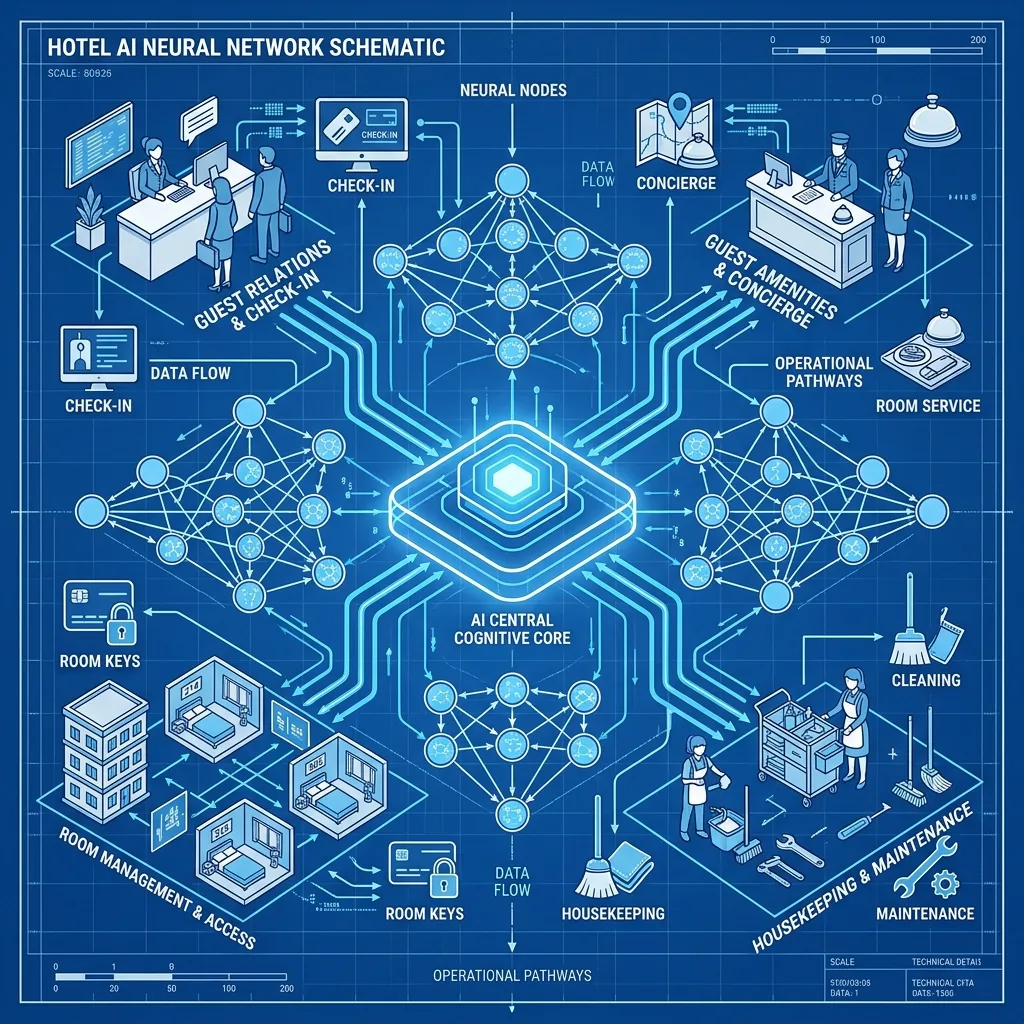
The most effective way to deploy AI in a hotel environment is not by replacing core systems, but by integrating AI models into a modern Guest Management System (GMS) layer. As we discussed in our post on upgrading legacy PMS systems, a GMS acts as the operational intelligence layer.
By weaving cutting-edge AI models (like Claude and Gemini) directly into this operational console, hotels can achieve significant efficiencies.
Practical Application 1: Night Time Automation
The night audit and graveyard shift are traditionally difficult to staff and prone to human error. AI excels here.
By deploying AI-driven intelligent workflows, hotels can automate routine front-desk tasks. The AI can handle late-night guest requests (e.g., “I need extra towels,” or “What time is checkout?”), process queue escalations instantly, and ensure flawless 24/7 operations. This drastically lowers overhead costs and allows the minimal night staff to focus on security and high-touch escalations.
(For a deeper look at AI integration, see our guide on choosing between Claude, GPT-4, and Gemini.)
Practical Application 2: Semantic Search for Guest Preferences
Traditional databases require exact keyword matches. If a guest asks for a “quiet room away from the elevator,” a standard system struggles to parse that intent automatically.
Modern AI, utilizing Retrieval-Augmented Generation (RAG) architectures, understands semantic intent. It can analyze past guest behavior, CRM notes, and current inventory to automatically allocate the perfect room, elevating the guest journey to a true luxury standard without manual intervention.
Practical Application 3: Multi-Lingual Instant Support
International travelers often face communication barriers. Integrating AI agents into your digital web check-in or mobile app provides instant, highly accurate translation and support. The AI can understand colloquialisms and context far better than legacy translation tools, providing a seamless experience for global guests.
(Learn more about integrating these tools using the Model Context Protocol (MCP).)
Moving Beyond the Hype
Implementing AI isn’t about replacing the human element of hospitality; it’s about removing the operational friction so your staff can focus on genuine guest connection.
Ready to implement practical AI solutions at your property? Contact NSDBytes to speak with our AI and hospitality engineering teams.
Related Articles
Frequently Asked Questions

Written by the NSDBytes Team
We are passionate about software development, AI integration, and helping businesses achieve operational excellence through modern technology.
Need something like this built?
We build and maintain our own hospitality products like GMS. Let us build yours.