When building AI-powered applications, one of the most consequential architectural decisions you’ll face is choosing how to make a large language model (LLM) “smarter” about your specific domain. Two approaches dominate the conversation: Retrieval-Augmented Generation (RAG) and fine-tuning. Both are powerful, both have trade-offs, and choosing the wrong one can cost your organization significant time, money, and momentum.
At NSDBytes, we work with founders, CTOs, and enterprise teams every day to navigate exactly this decision. This guide breaks down both approaches clearly so you can make the right call for your AI project.
Understanding the Core Difference
Before diving into trade-offs, it helps to understand what each approach actually does under the hood.
What Is Fine-Tuning?
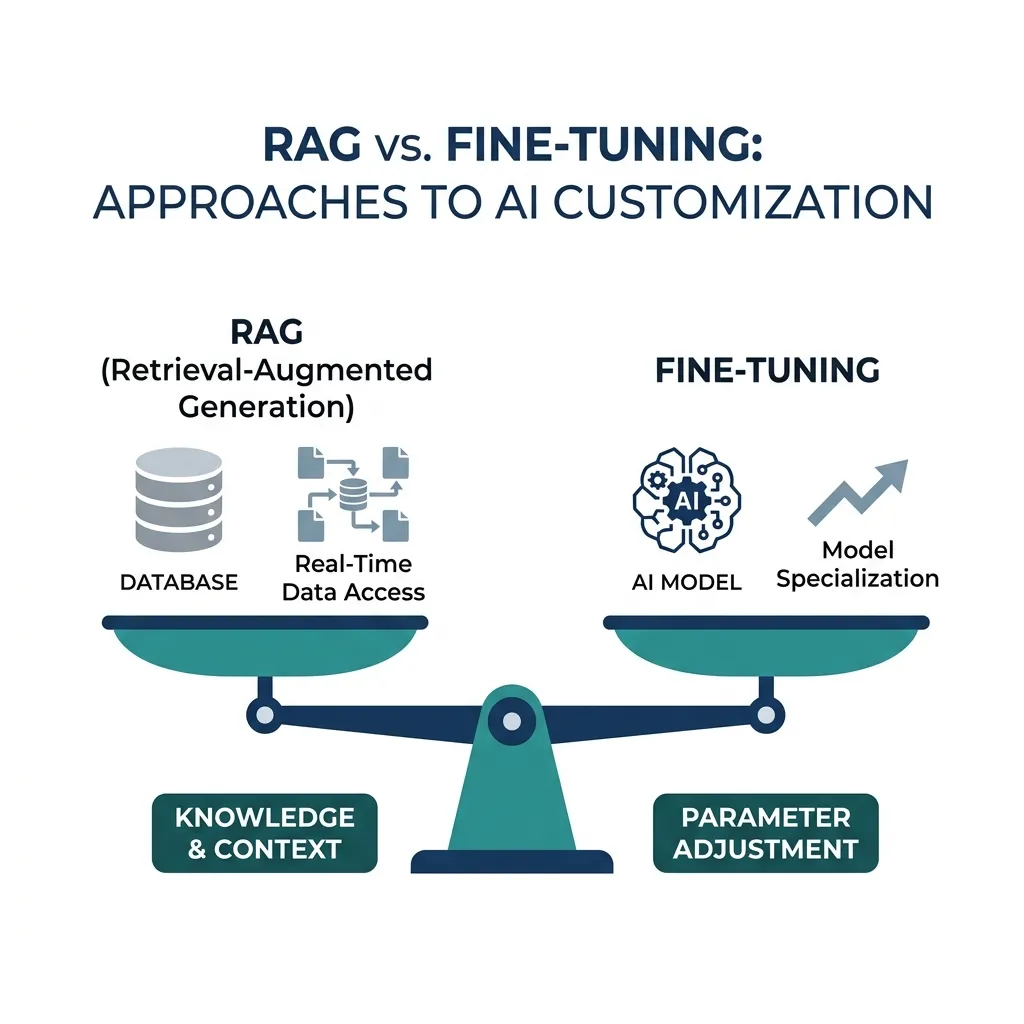
Fine-tuning involves taking a pre-trained LLM and continuing its training on a curated dataset specific to your domain, use case, or style. Think of it as sending the model back to school — you’re modifying its weights so it inherently knows things it didn’t know before, or behaves in ways it previously didn’t.
Common use cases include:
- Teaching a model your brand’s specific tone and voice
- Training it to follow a very particular output format (e.g., structured JSON, legal clauses)
- Embedding deep domain expertise that rarely changes (e.g., medical coding standards, industry-specific terminology)
What Is RAG (Retrieval-Augmented Generation)?
RAG takes a different approach. Instead of changing the model itself, you build a system that retrieves relevant information at query time and feeds it as context into the model’s prompt. The model uses that retrieved data — pulled from your documents, databases, or knowledge bases — to generate accurate, grounded responses.
Think of RAG as giving the model access to a well-organized library right before it answers a question. The model stays the same; the context changes dynamically.
Common use cases include:
- Customer support bots with access to live product documentation
- Internal knowledge assistants that search across company wikis and SOPs
- Legal or compliance tools that reference up-to-date regulatory documents
Comparing the Two: Key Dimensions
1. Knowledge Freshness
This is often the decisive factor for business applications.
RAG wins here — decisively. Because RAG pulls information at query time, your AI stays current as long as you update your data sources. A product catalog update, a new policy document, or a regulatory change is immediately available to the model without any retraining.
Fine-tuning, by contrast, bakes knowledge into model weights at a fixed point in time. If your business environment changes frequently, you’ll face recurring retraining cycles — which are expensive and time-consuming.
2. Cost and Infrastructure
- Fine-tuning requires significant compute resources for training, plus the overhead of managing model versions, evaluation pipelines, and deployment infrastructure. For smaller teams, this can be prohibitive.
- RAG requires a vector database (such as Pinecone, Weaviate, or pgvector), an embedding model, and a retrieval pipeline — but these are generally cheaper to set up and maintain, especially with managed services.
Our team at NSDBytes typically finds that RAG delivers faster time-to-value, especially for organizations earlier in their AI journey. You can prototype a RAG system in days; fine-tuning a production-ready model often takes weeks.
3. Accuracy and Hallucination Risk
Fine-tuned models can be highly precise within their domain — but they can also hallucinate confidently if asked about something outside their training distribution. RAG mitigates hallucination by anchoring responses in retrieved source documents. When the model cites your actual documentation, there’s a traceable, verifiable source behind every answer.
That said, RAG introduces its own failure modes: poor retrieval quality, chunking issues, or irrelevant context can degrade output significantly. The quality of your RAG pipeline is only as good as your data architecture.
4. Behavioral Customization
Here, fine-tuning has the clear edge. If you need the model to consistently respond in a specific format, follow a strict persona, or adopt nuanced domain-specific reasoning patterns, fine-tuning gives you that level of control. RAG can influence behavior somewhat through system prompts, but it cannot fundamentally reshape how the model “thinks.”
For example, if you need a model that reliably outputs structured insurance claim summaries in a very particular schema — every single time, without deviation — fine-tuning is the more reliable path.
5. Data Privacy and Security
Both approaches require careful thought here, but they present different risk surfaces.
- RAG systems expose your retrieval pipeline to potential prompt injection or data leakage if not secured properly. However, your proprietary data stays in your infrastructure and is never used to train a shared model.
- Fine-tuning with a third-party provider means your training data is shared with that provider. For highly sensitive data (healthcare, legal, financial), this may be a non-starter without on-premise infrastructure.
At NSDBytes, we always conduct a data governance review before recommending either approach to clients in regulated industries.
Can You Use Both? (Spoiler: Yes)
This is where many teams discover the most powerful path forward. RAG and fine-tuning are not mutually exclusive — in fact, combining them often yields the best results.
A practical hybrid architecture might look like:
- Fine-tune the model on your domain’s tone, formatting requirements, and core reasoning patterns
- Augment it with RAG to inject real-time, specific knowledge at query time
This gives you the behavioral consistency of fine-tuning with the knowledge freshness and traceability of RAG. Our engineering teams have deployed this pattern for clients in healthcare technology, legal SaaS, and enterprise knowledge management with excellent results.
How to Choose: A Decision Framework
Use these questions to guide your decision:
- How frequently does your source knowledge change? → If often, lean toward RAG.
- Do you need highly specific output formats or behaviors? → Fine-tuning may be necessary.
- What is your budget and timeline? → RAG typically gets to production faster and cheaper.
- Are you working with sensitive proprietary data? → Evaluate your fine-tuning provider’s data policies carefully.
- Do you need explainability and auditability? → RAG offers stronger traceability.
- Is your use case highly conversational or document-grounded? → Document-heavy use cases favor RAG strongly.
Final Thoughts
There is no universally “correct” answer between RAG and fine-tuning — there is only the right answer for your specific context, constraints, and goals. The worst outcome is choosing an approach based on hype or a competitor’s blog post without grounding it in your actual requirements.
At NSDBytes, we help technology leaders cut through the noise and make AI architecture decisions with confidence. Whether you’re evaluating RAG pipelines, planning a fine-tuning initiative, or designing a hybrid system, our team brings both the technical depth and the strategic perspective to move your project forward efficiently.
Ready to architect the right solution for your AI product? Reach out to the NSDBytes team — we’d love to help you build something that actually works in production.
Related Articles
Frequently Asked Questions

Written by the NSDBytes Team
We are passionate about software development, AI integration, and helping businesses achieve operational excellence through modern technology.
Need something like this built?
We’ve helped 200+ companies ship AI-powered solutions. Let's build your AI product.