When your AI application starts returning confidently wrong answers, the problem usually isn’t your language model — it’s how you’re storing and retrieving the knowledge it needs. That’s where vector databases become the unsung heroes of production-grade AI systems, and why choosing the right one can make or break your Retrieval-Augmented Generation (RAG) architecture.
At NSDBytes, we’ve built RAG pipelines across dozens of enterprise projects, and the question we hear most often from CTOs and founders is: “Which vector database should we use?” The honest answer is: it depends. But let’s break down what it actually depends on.
What Makes Vector Databases Different — and Why RAG Needs Them
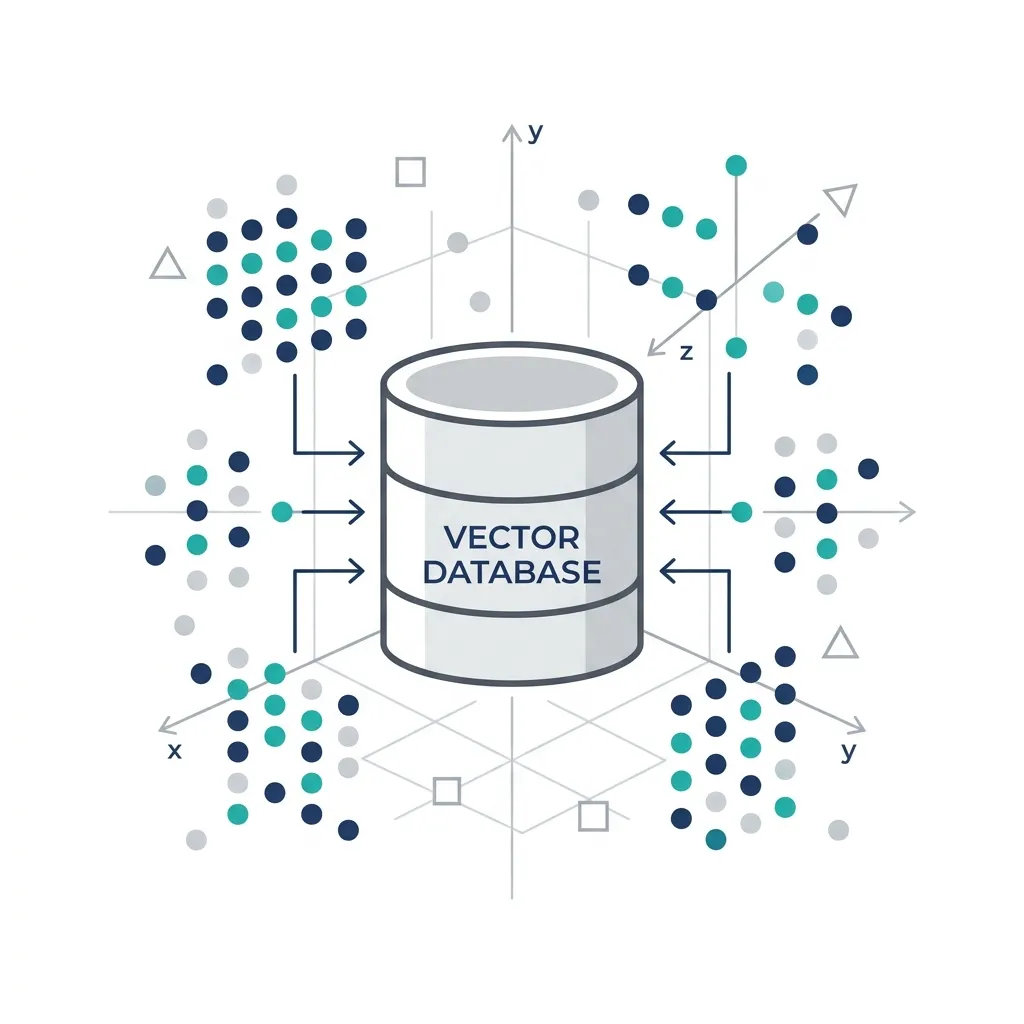
Traditional relational databases store structured data and retrieve it via exact matches. Vector databases, on the other hand, store high-dimensional numerical representations (embeddings) of unstructured data — documents, images, audio, or code — and retrieve results based on semantic similarity.
In a RAG system, when a user asks a question, the system converts that query into a vector, searches the database for the most semantically similar chunks of information, and feeds those results to the LLM as context. This is what allows AI applications to answer questions based on your proprietary data, not just what the model learned during training.
The quality of that retrieval step is everything. A poorly chosen vector database introduces latency, limits scalability, or delivers imprecise results — all of which degrade the user experience and erode trust in your AI system.
The Three Leading Contenders
Our team has evaluated and deployed all three of these platforms in real-world scenarios. Here’s what you actually need to know.
Pinecone: The Managed Simplicity Champion
Pinecone is a fully managed, cloud-native vector database purpose-built for production AI workloads. If your team wants to skip infrastructure management entirely and focus on building, Pinecone is designed for exactly that.
Key strengths:
- Zero infrastructure overhead — no servers to provision, no clusters to tune
- Consistent low latency at scale, even with billions of vectors
- Namespaces allow logical separation of data within a single index, useful for multi-tenant applications
- Seamless integrations with LangChain, LlamaIndex, and OpenAI ecosystems
- Enterprise-grade security and SOC 2 compliance out of the box
Where it falls short:
- Fully proprietary — you’re locked into Pinecone’s cloud infrastructure
- Cost scales quickly at high query volumes; can become expensive for large-scale deployments
- Limited customization of the underlying indexing algorithm
- No self-hosted option for organizations with strict data residency requirements
Best for: Startups and scale-ups that need to move fast, enterprises without a dedicated MLOps team, and use cases where time-to-production matters more than infrastructure control.
Weaviate: The Hybrid Search Powerhouse
Weaviate is an open-source vector database that goes beyond pure vector search by combining it with BM25 keyword search in a native hybrid retrieval mode. This is a significant architectural advantage for RAG systems where documents contain specific terminology, product names, or codes that semantic search alone might miss.
Key strengths:
- Hybrid search out of the box — semantic + keyword retrieval without additional tooling
- GraphQL-based query interface that enables complex, multi-hop data retrieval
- Modular vectorizer architecture — plug in OpenAI, Cohere, HuggingFace, or custom models
- Available as both a managed cloud service (Weaviate Cloud) and self-hosted
- Built-in support for multi-tenancy, making it ideal for SaaS platforms
- Active open-source community and strong enterprise support options
Where it falls short:
- Steeper learning curve, especially the GraphQL query model
- Self-hosted deployments require meaningful DevOps expertise to operate at scale
- Resource consumption can be higher compared to leaner alternatives
Best for: Enterprise RAG applications where retrieval precision is critical, organizations building multi-tenant AI products, and teams that want flexibility between cloud and on-premise deployment.
Qdrant: The Performance-First Open-Source Option
Qdrant is a high-performance, open-source vector search engine written in Rust — and that choice of language is intentional. It prioritizes raw speed, memory efficiency, and precise control over indexing behavior. For teams with specific performance requirements or those building on constrained infrastructure, Qdrant deserves serious consideration.
Key strengths:
- Exceptional throughput and low memory footprint thanks to its Rust implementation
- Payload filtering allows powerful pre- and post-filtering on metadata alongside vector search
- Quantization support (scalar and product quantization) reduces memory usage significantly without dramatic accuracy loss
- Full self-hosting capability with a clean REST and gRPC API
- Qdrant Cloud offers a managed option for teams that want simplicity
- Transparent, permissive Apache 2.0 license with no vendor lock-in
Where it falls short:
- Smaller ecosystem compared to Pinecone and Weaviate
- Fewer pre-built integrations, requiring more manual setup in some frameworks
- The managed cloud offering is newer and less battle-tested than Pinecone
Best for: Performance-critical applications, teams with strong engineering capability who want infrastructure control, cost-sensitive deployments where efficiency matters, and organizations with strict data sovereignty requirements.
How to Choose: A Decision Framework
At NSDBytes, we guide our clients through this decision using four key dimensions:
1. Operational Model Do you want managed infrastructure or self-hosted control? If you have no MLOps capacity, lean toward Pinecone. If data residency or customization matters, Weaviate or Qdrant give you more latitude.
2. Retrieval Complexity Pure semantic search? Any of the three works well. Need hybrid keyword + semantic retrieval natively? Weaviate has the most mature implementation. Need complex metadata filtering alongside vector search? Qdrant’s payload filtering is notably powerful.
3. Scale and Cost Profile At lower query volumes, cost differences are marginal. At enterprise scale, the economics shift dramatically. Qdrant’s efficiency and open-source licensing can represent significant savings. Pinecone’s pricing model rewards teams that can optimize query volume carefully.
4. Ecosystem and Integration Needs If your stack is already built around LangChain, LlamaIndex, or OpenAI, all three integrate well — but Pinecone’s documentation and community examples are most abundant. Weaviate and Qdrant are catching up quickly.
The Architecture Perspective: It’s Not Just the Database
Our team consistently reminds clients that the vector database is one component in a broader RAG architecture. Chunking strategy, embedding model selection, re-ranking layers, and context window management all interact with your database choice. A well-tuned Qdrant deployment with smart chunking will outperform a poorly configured Pinecone setup every time.
The best vector database is the one your team can operate effectively, at a cost that makes business sense, with the retrieval quality your use case demands.
Making the Right Call for Your Business
Choosing between Pinecone, Weaviate, and Qdrant isn’t just a technical decision — it’s a business one. It affects your development velocity, operational costs, compliance posture, and the long-term maintainability of your AI infrastructure.
At NSDBytes, we don’t believe in one-size-fits-all recommendations. We assess your specific workload, team capabilities, compliance requirements, and growth trajectory before making a recommendation. What we do believe in is building AI systems that perform reliably in production — not just in demos.
If you’re architecting a RAG system and want an expert perspective on which vector database fits your specific context, our team is ready to help you make that decision with confidence.
Related Articles
Frequently Asked Questions
Written by the NSDBytes Team
We are passionate about software development, AI integration, and helping businesses achieve operational excellence through modern technology.
Need something like this built?
We’ve helped 200+ companies ship AI-powered solutions. Let's build your AI product.